Maximum Product Cutting Problem
Question
Given a positive integer \(n\), split it into the sum of at least two positive integers and find the maximum product of the resulting integers, as shown in the figure below.
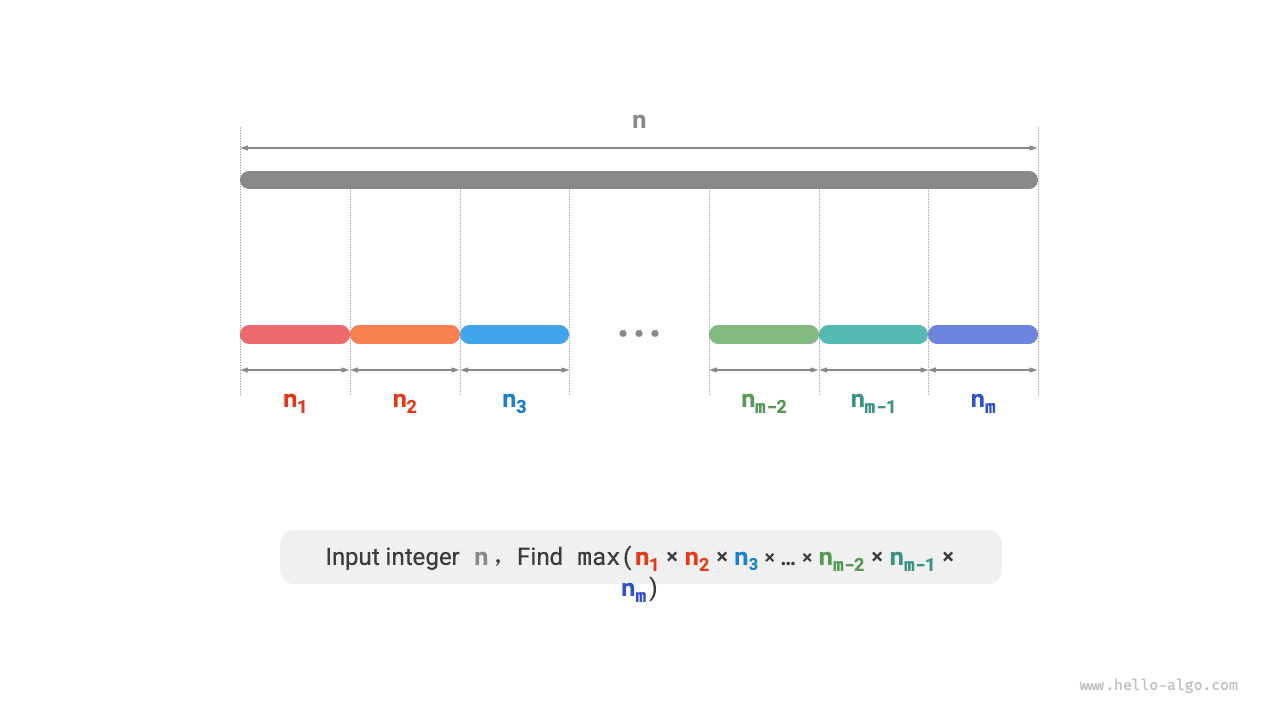
Suppose we split \(n\) into \(m\) integer factors, where the \(i\)-th factor is denoted as \(n_i\), that is
The goal of this problem is to find the maximum product of all integer factors, namely
We need to determine how many parts \(m\) there should be and what each \(n_i\) should be.
Determining the Greedy Strategy
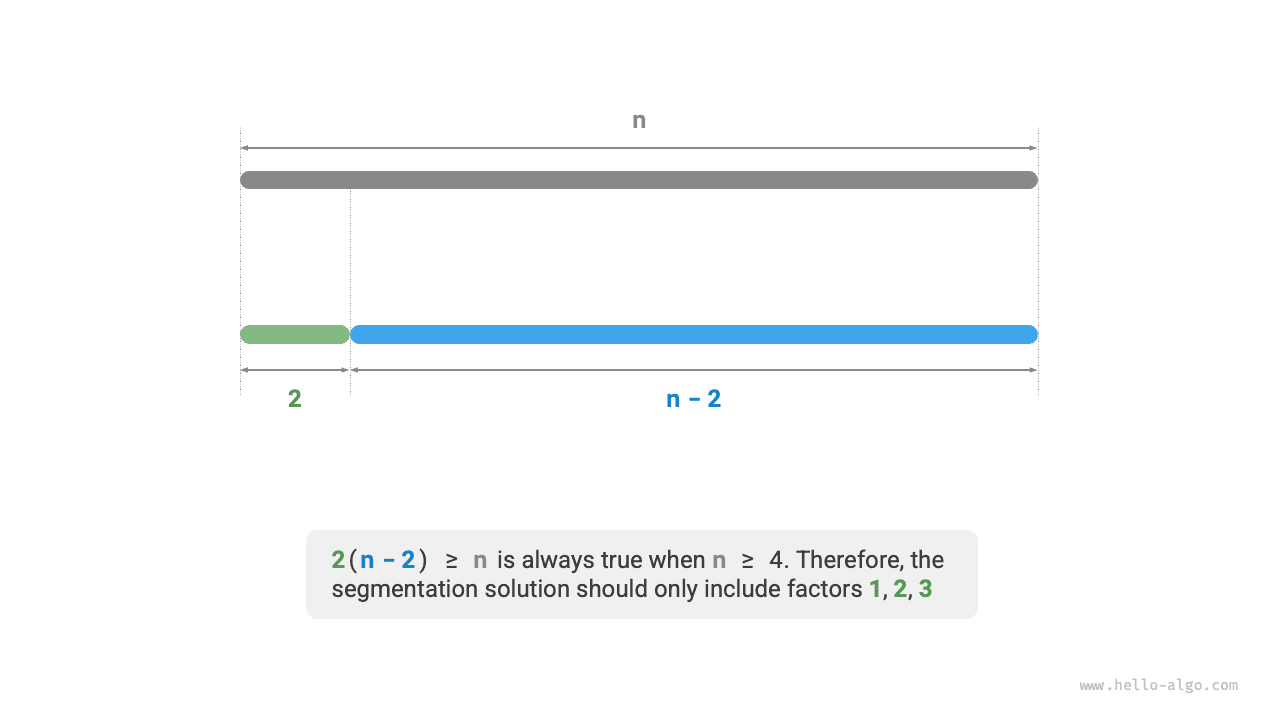
As a rule of thumb, the product of two integers is often greater than their sum. Suppose we split off a factor of \(2\) from \(n\); the resulting product is \(2(n-2)\). We compare this product with \(n\):
As shown in the figure below, when \(n \geq 4\), splitting out a \(2\) will increase the product, which indicates that integers greater than or equal to \(4\) should all be split.
Greedy strategy one: If the splitting scheme contains a factor \(\geq 4\), it should be split further. The final splitting scheme should contain only the factors \(1\), \(2\), and \(3\).
Next, consider which factor is optimal. Among the three factors \(1\), \(2\), and \(3\), clearly \(1\) is the worst, because \(1 \times (n-1) < n\) always holds, meaning splitting out \(1\) will actually decrease the product.
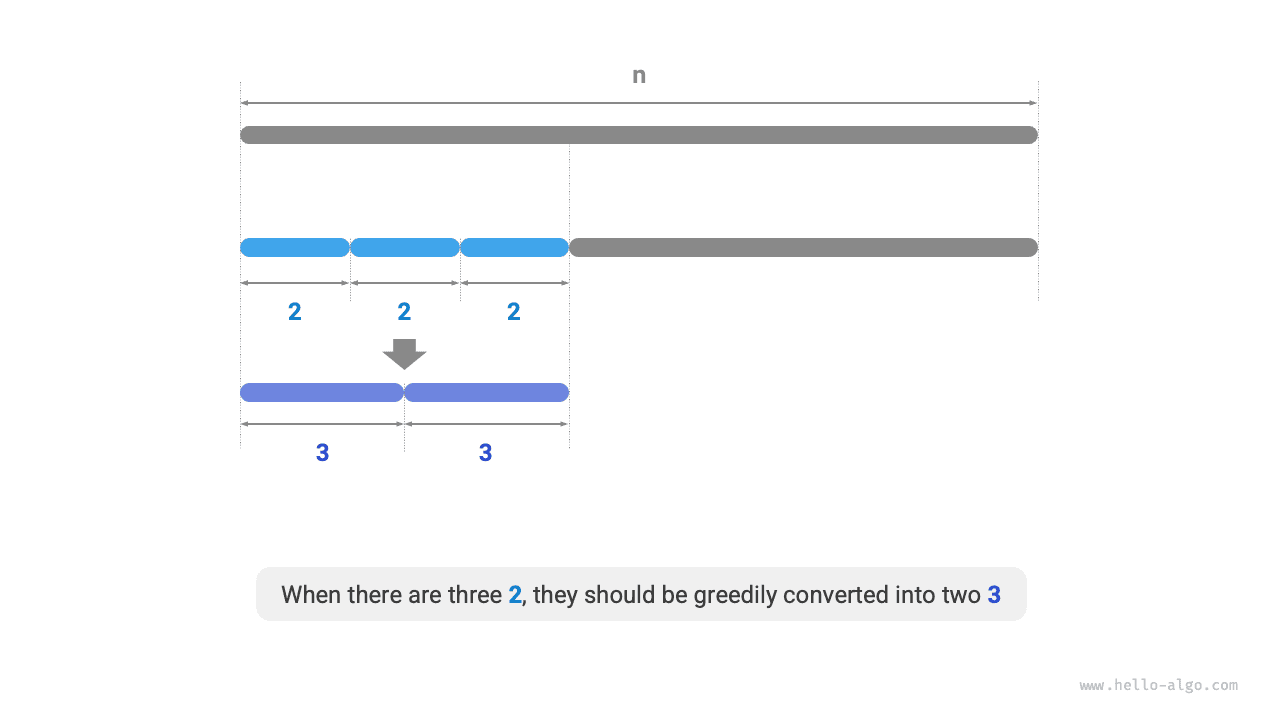
As shown in the figure below, when \(n = 6\), we have \(3 \times 3 > 2 \times 2 \times 2\). This means that splitting out \(3\) is better than splitting out \(2\).
Greedy strategy two: In the splitting scheme, there should be at most two \(2\)s, because three \(2\)s can always be replaced by two \(3\)s to obtain a larger product.
In summary, the following greedy strategies can be derived.
- Input integer \(n\), continuously split out factor \(3\) until the remainder is \(0\), \(1\), or \(2\).
- When the remainder is \(0\), it means \(n\) is a multiple of \(3\), so no further action is needed.
- When the remainder is \(2\), do not split it further; keep it as is.
- When the remainder is \(1\), since \(2 \times 2 > 1 \times 3\), replace the final \(3\) and the remaining \(1\) with two \(2\)s.
Code Implementation
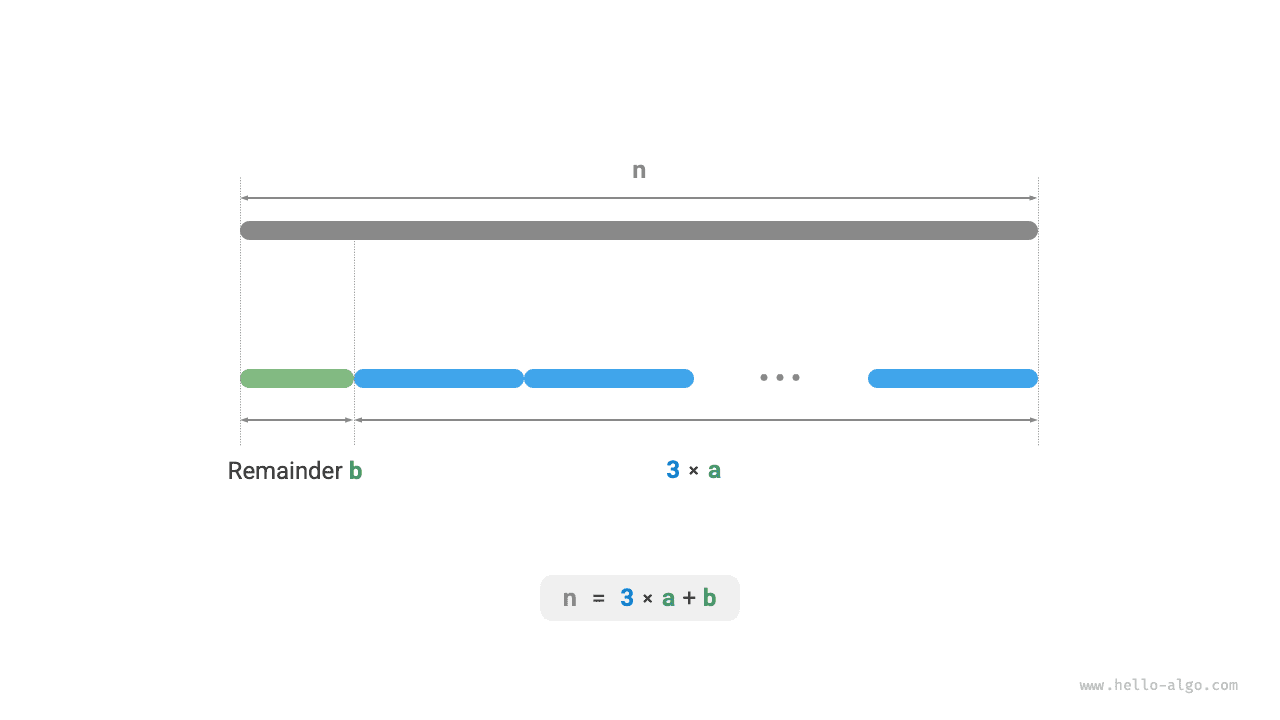
As shown in the figure below, we do not need loops to split the integer. Instead, we use integer division to obtain the number of \(3\)s, denoted by \(a\), and the modulo operation to obtain the remainder \(b\), giving:
Please note that for the edge case of \(n \leq 3\), a \(1\) must be split out, with product \(1 \times (n - 1)\).
The time complexity depends on how exponentiation is implemented in the programming language. Taking Python as an example, there are three commonly used ways to compute powers.
- Both the operator
**and the functionpow()have time complexity \(O(\log a)\). - The function
math.pow()internally calls the C library'spow()function, which performs floating-point exponentiation, with time complexity \(O(1)\).
Variables \(a\) and \(b\) use a constant amount of extra space, therefore the space complexity is \(O(1)\).
Correctness Proof
We use proof by contradiction and consider only the case where \(n \geq 4\).
- All factors \(\leq 3\): Suppose the optimal splitting scheme includes a factor \(x \geq 4\). Then it can be further split into \(2(x-2)\) to obtain a larger (or equal) product. This contradicts the assumption.
- The splitting scheme does not contain \(1\): Suppose the optimal splitting scheme includes a factor of \(1\). Then it can be merged into another factor to obtain a larger product. This contradicts the assumption.
- The splitting scheme contains at most two \(2\)s: Suppose the optimal splitting scheme includes three \(2\)s. Then they can be replaced by two \(3\)s, yielding a larger product. This contradicts the assumption.