Binary Tree Traversal
From a physical structure perspective, a tree is a data structure based on linked lists. Hence, its traversal method involves accessing nodes one by one through pointers. However, a tree is a non-linear data structure, which makes traversing a tree more complex than traversing a linked list, requiring the assistance of search algorithms.
The common traversal methods for binary trees include level-order traversal, pre-order traversal, in-order traversal, and post-order traversal.
Level-Order Traversal
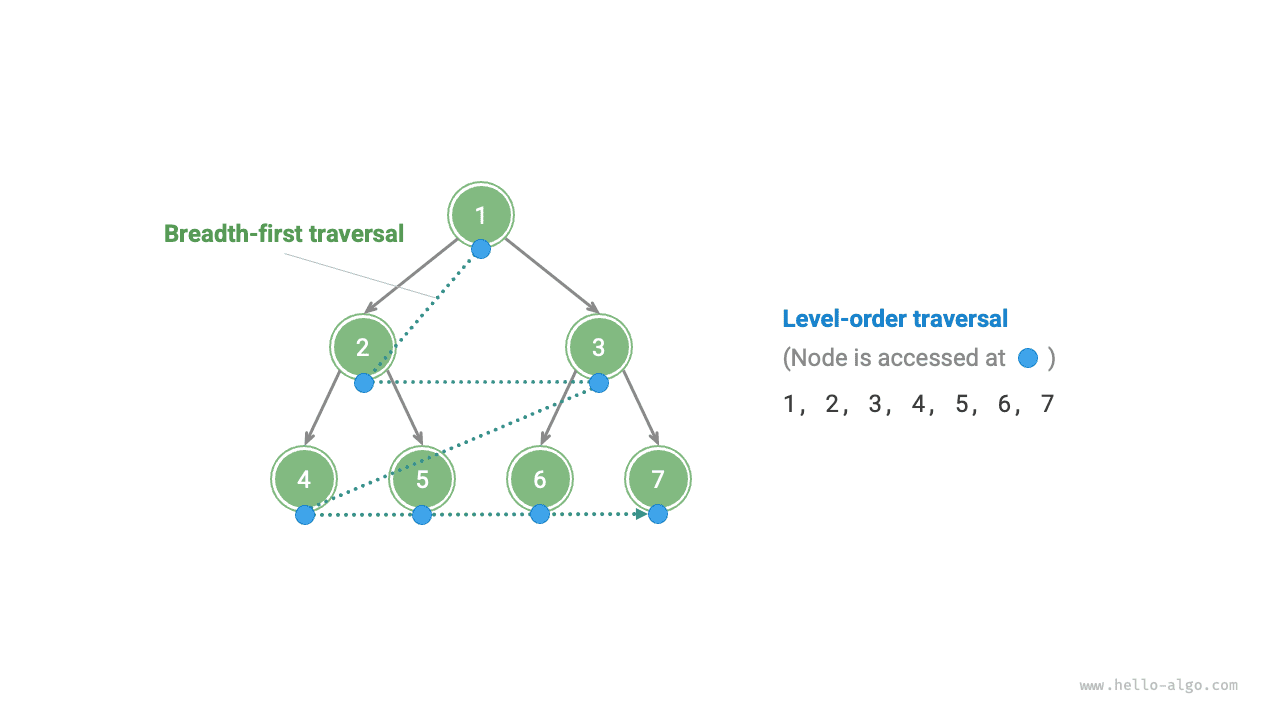
As shown in the figure below, level-order traversal traverses the binary tree from top to bottom, layer by layer. Within each level, it visits nodes from left to right.
Level-order traversal is essentially breadth-first traversal, also known as breadth-first search (BFS), which proceeds outward level by level.
Code Implementation
Breadth-first traversal is typically implemented with the help of a "queue". The queue follows the "first in, first out" rule, while breadth-first traversal follows the "layer-by-layer progression" rule; the underlying ideas of the two are consistent. The implementation code is as follows:
Complexity Analysis
- Time complexity is \(O(n)\): All nodes are visited once, using \(O(n)\) time, where \(n\) is the number of nodes.
- Space complexity is \(O(n)\): In the worst case, i.e., a full binary tree, before traversing to the bottom level, the queue contains at most \((n + 1) / 2\) nodes simultaneously, occupying \(O(n)\) space.
Preorder, Inorder, and Postorder Traversal
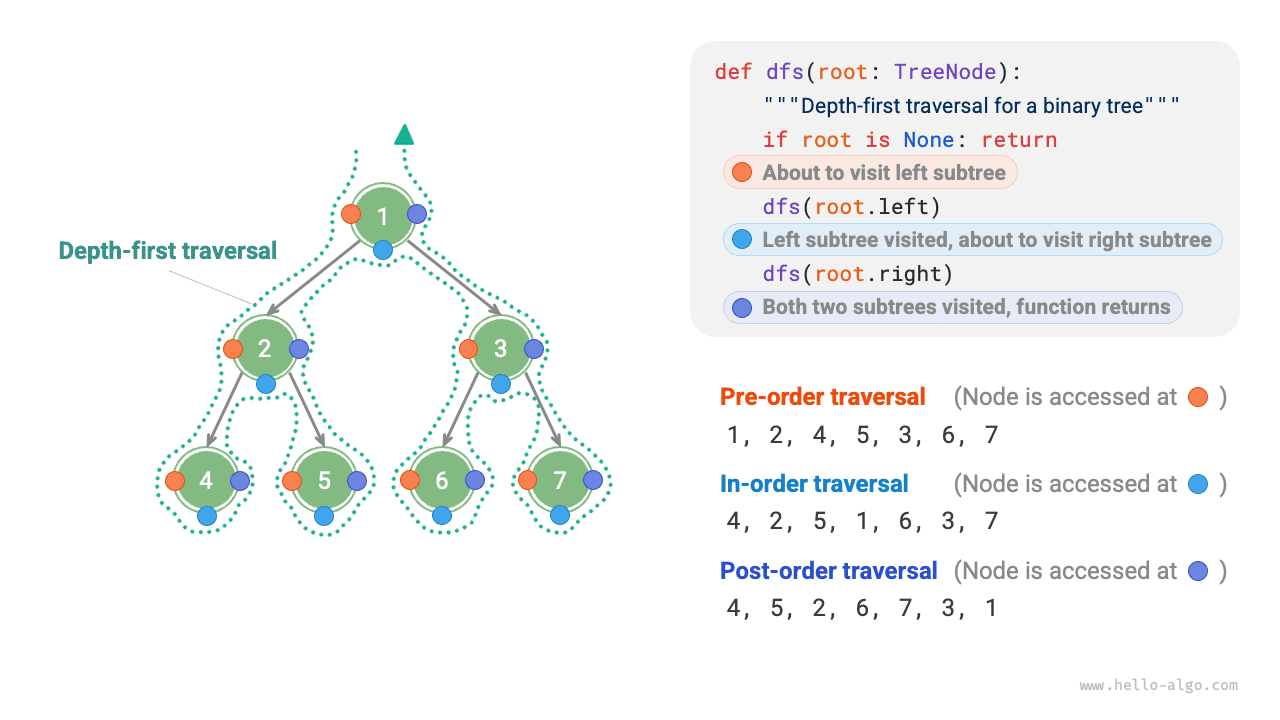
Correspondingly, preorder, inorder, and postorder traversals all belong to depth-first traversal, also known as depth-first search (DFS), which goes as deep as possible before backtracking.
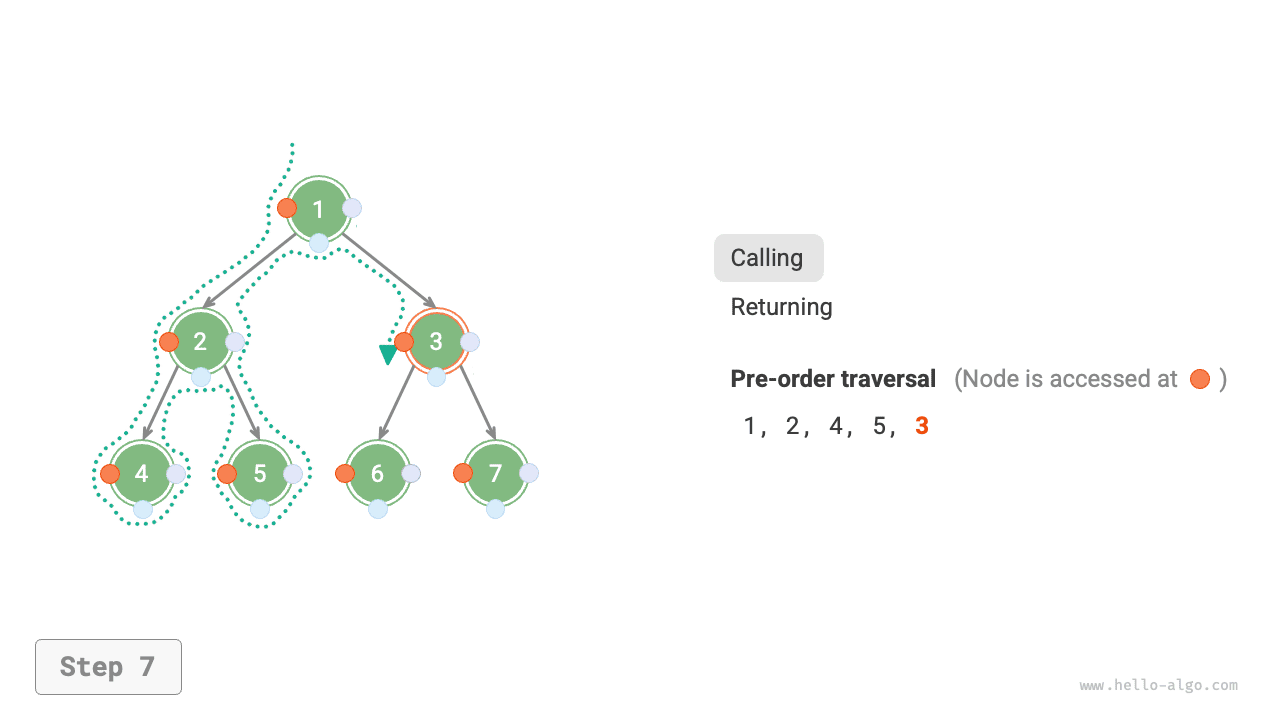
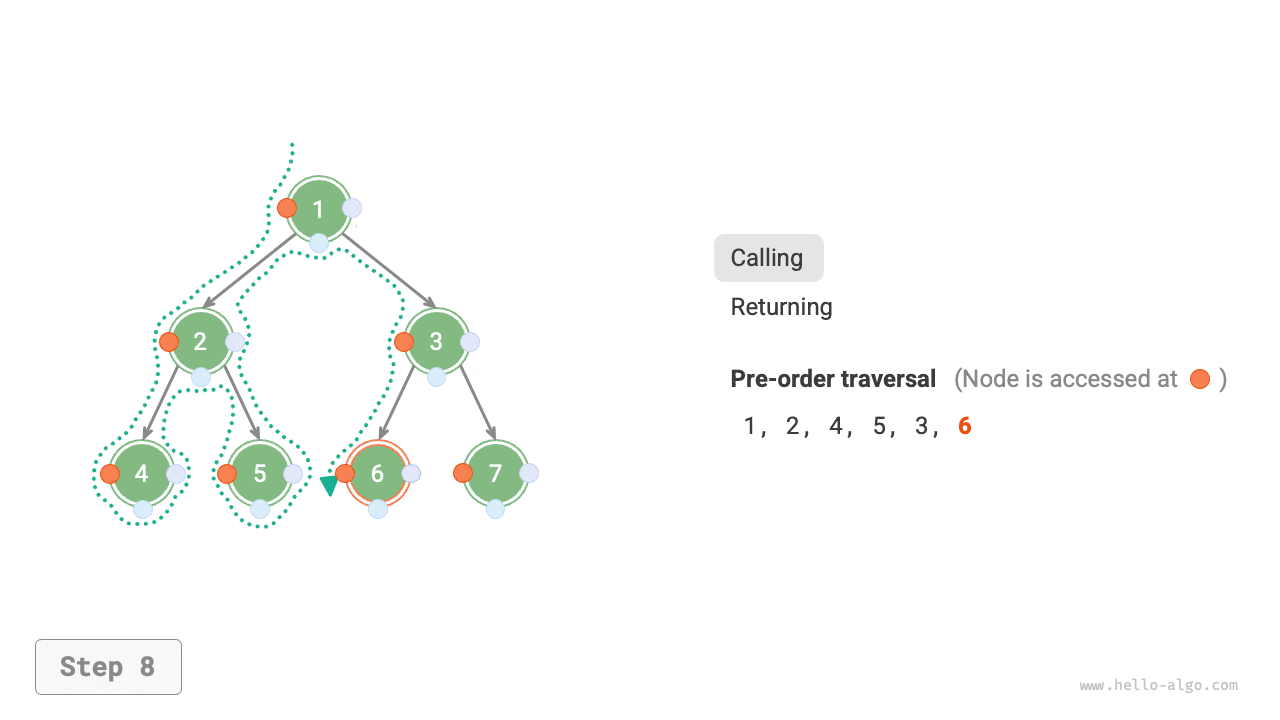
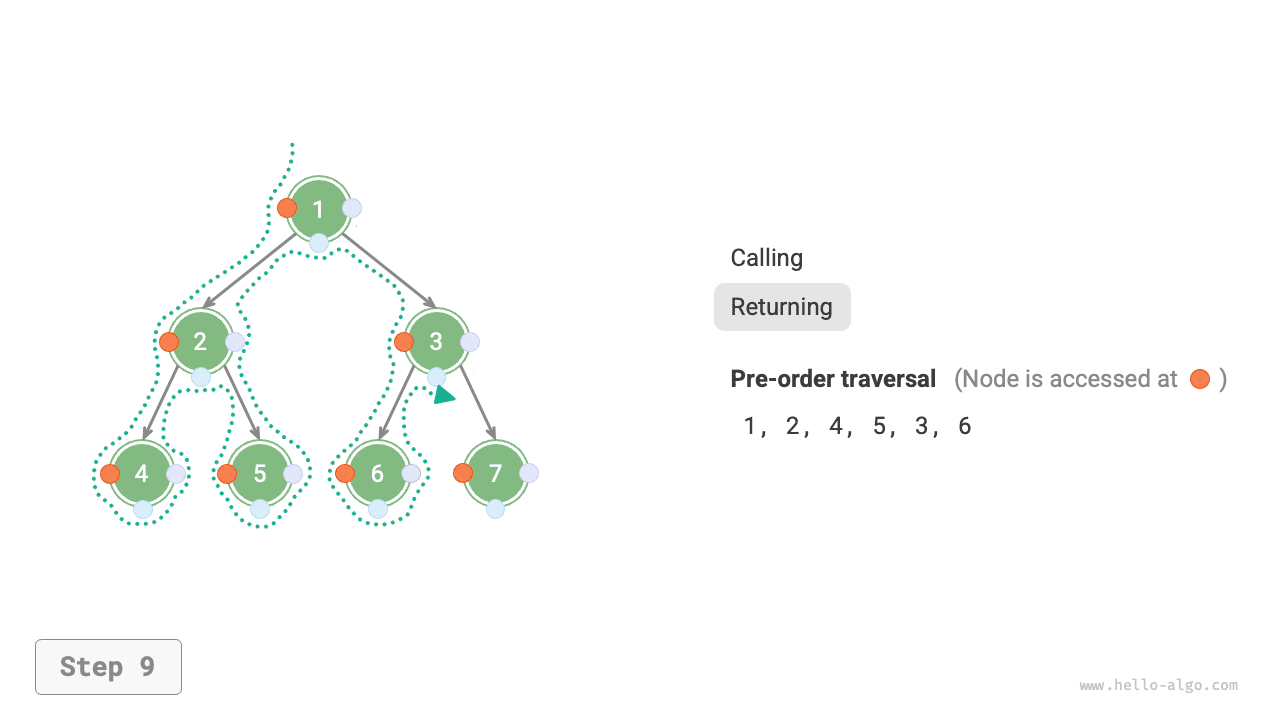
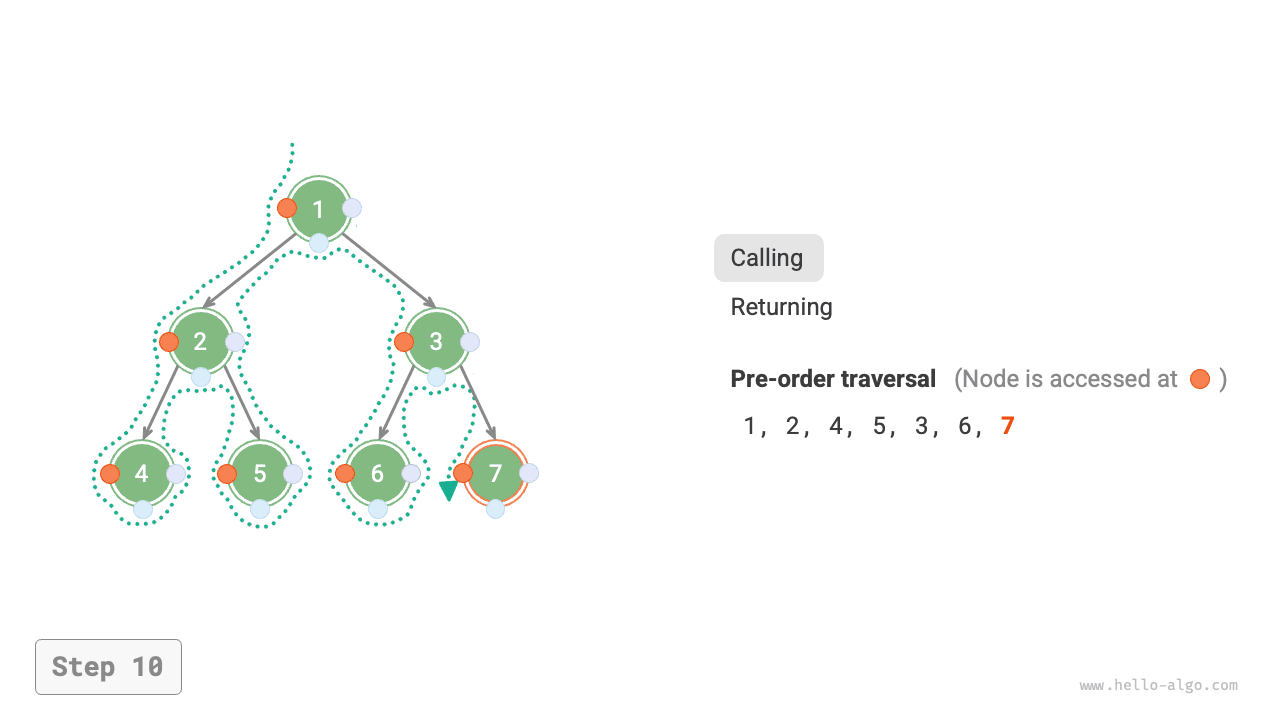
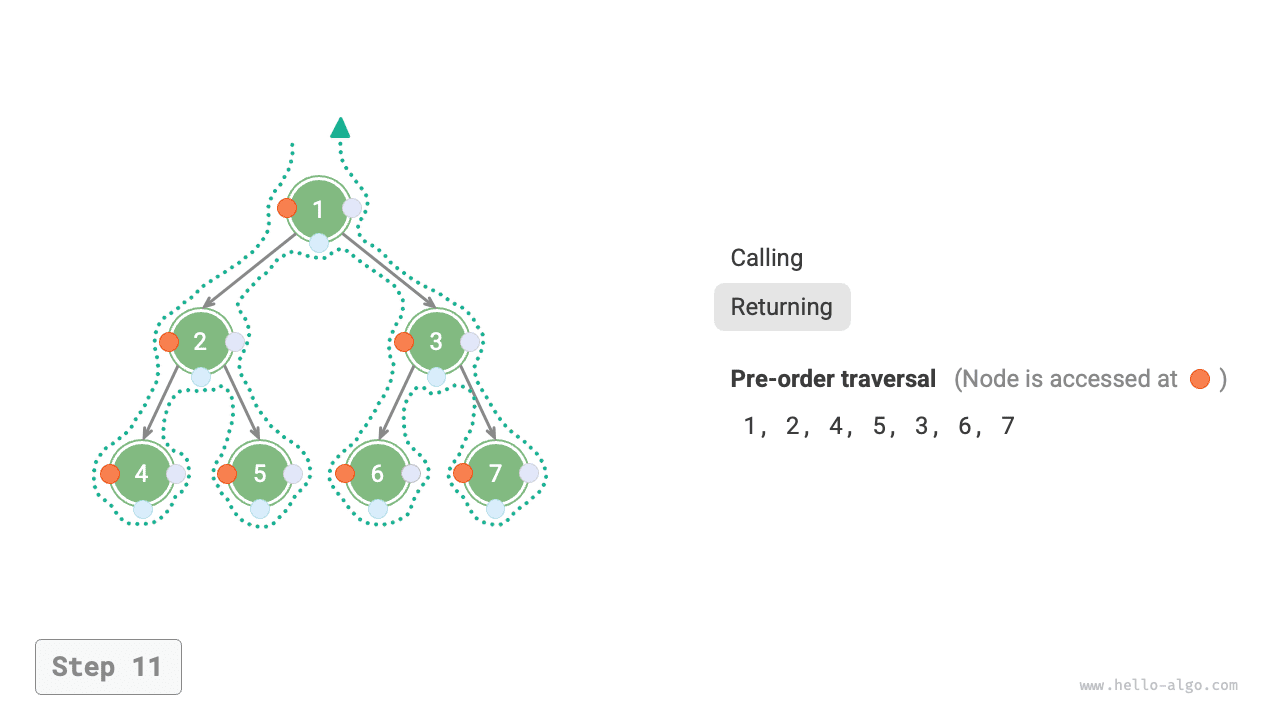
The figure below shows how depth-first traversal works on a binary tree. Depth-first traversal is like "walking" around the perimeter of the entire binary tree, encountering three positions at each node, corresponding to preorder, inorder, and postorder traversal.
Code Implementation
Depth-first search is usually implemented based on recursion:
Tip
Depth-first search can also be implemented iteratively, and interested readers can explore this on their own.
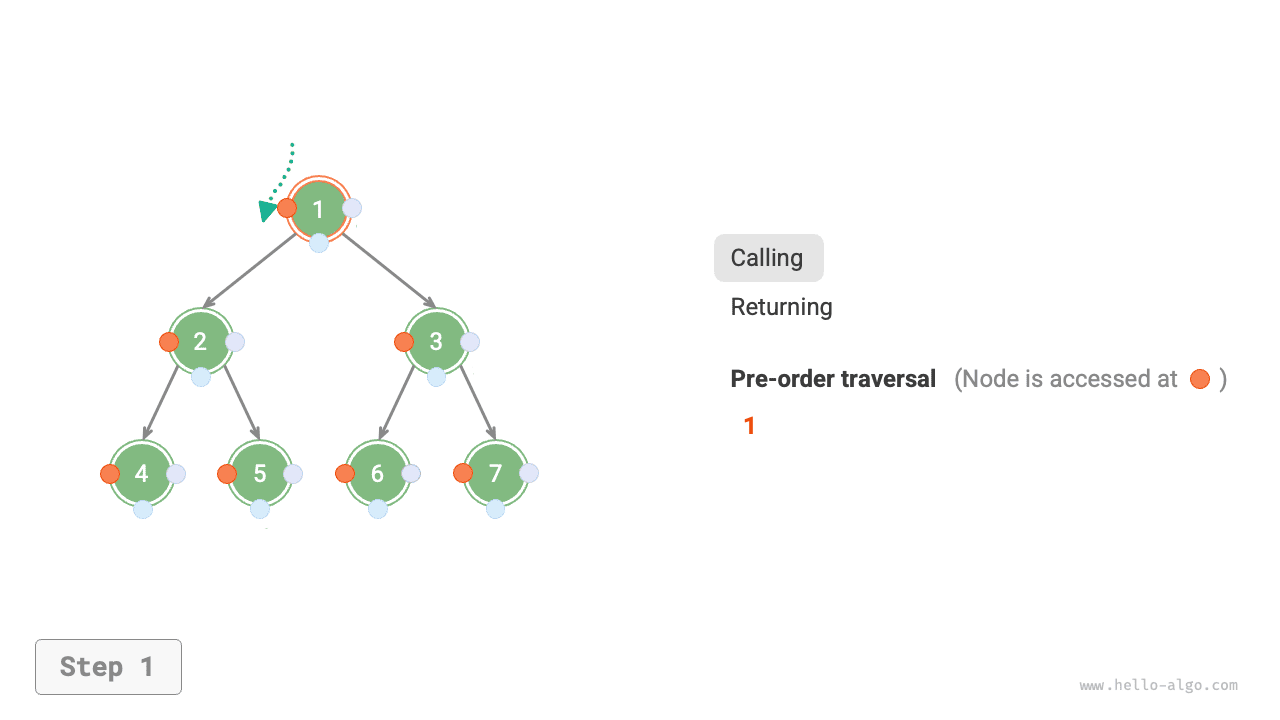
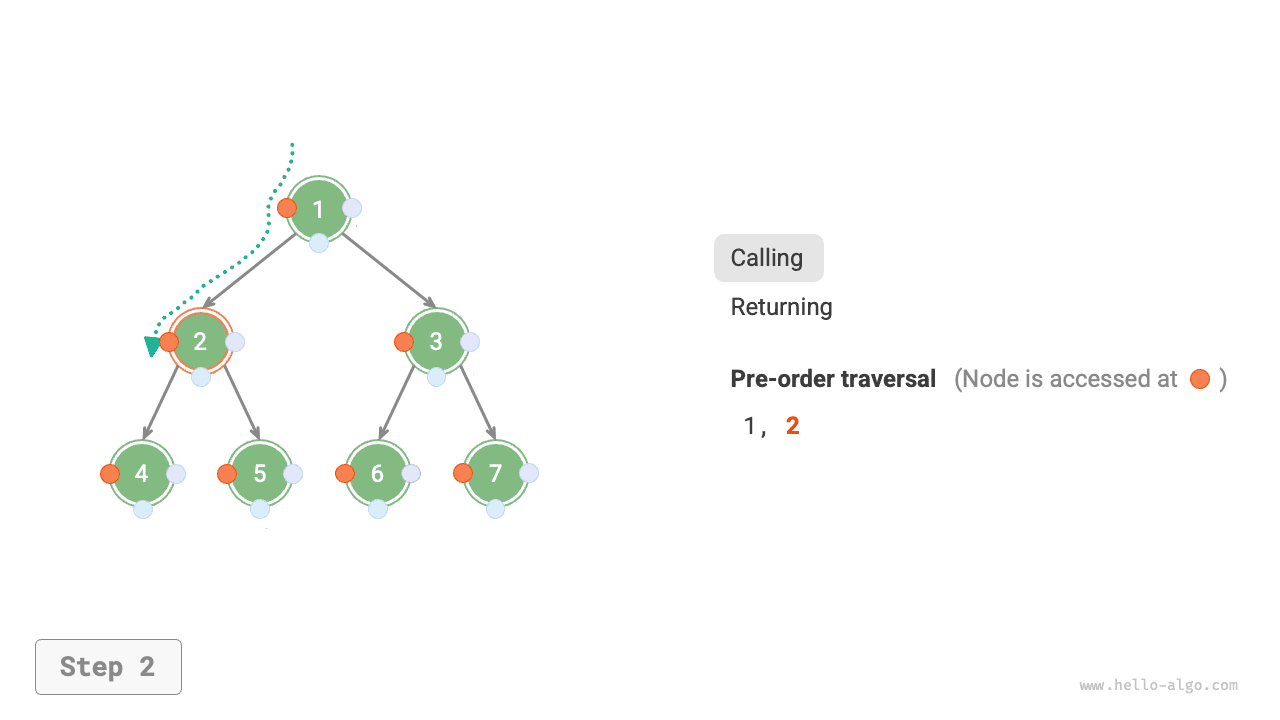
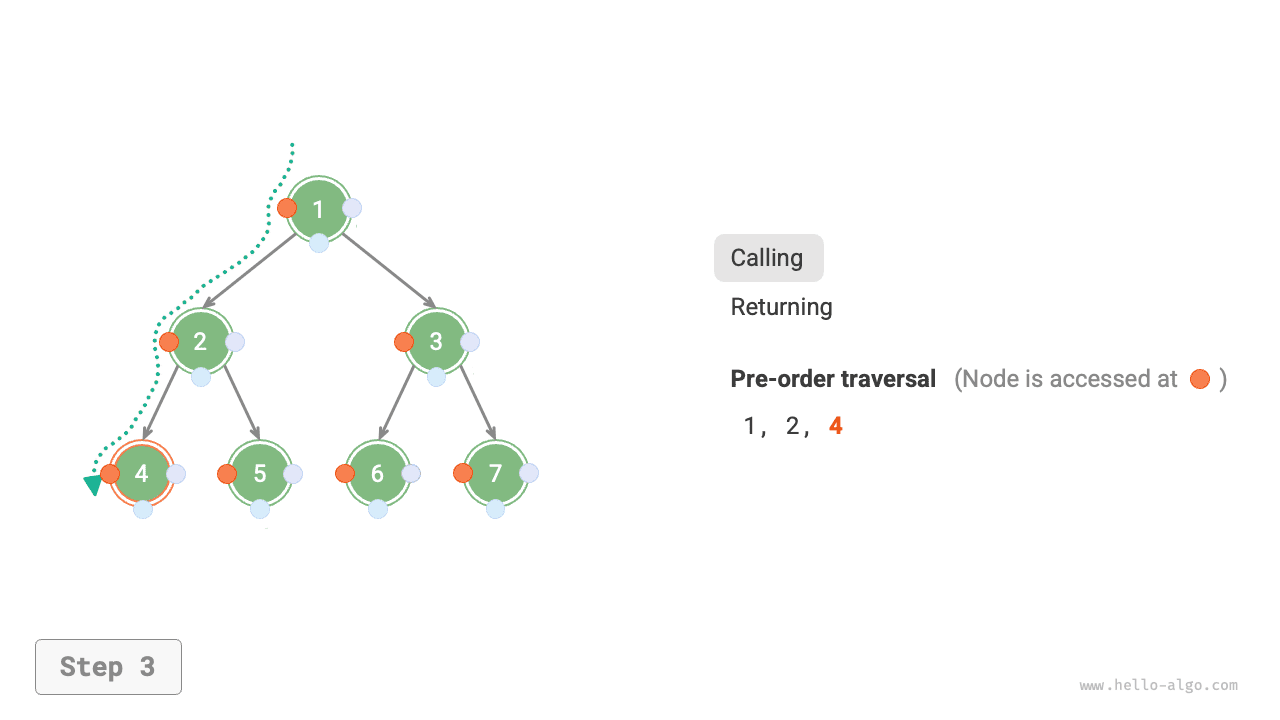
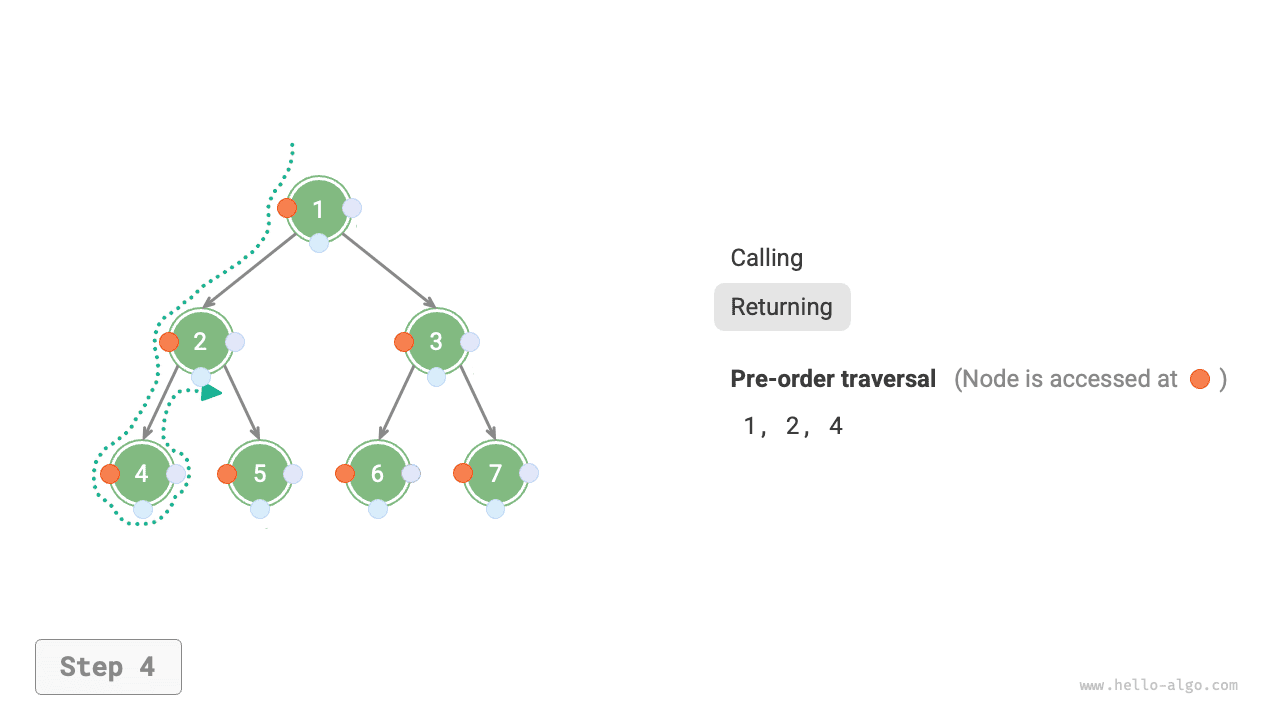
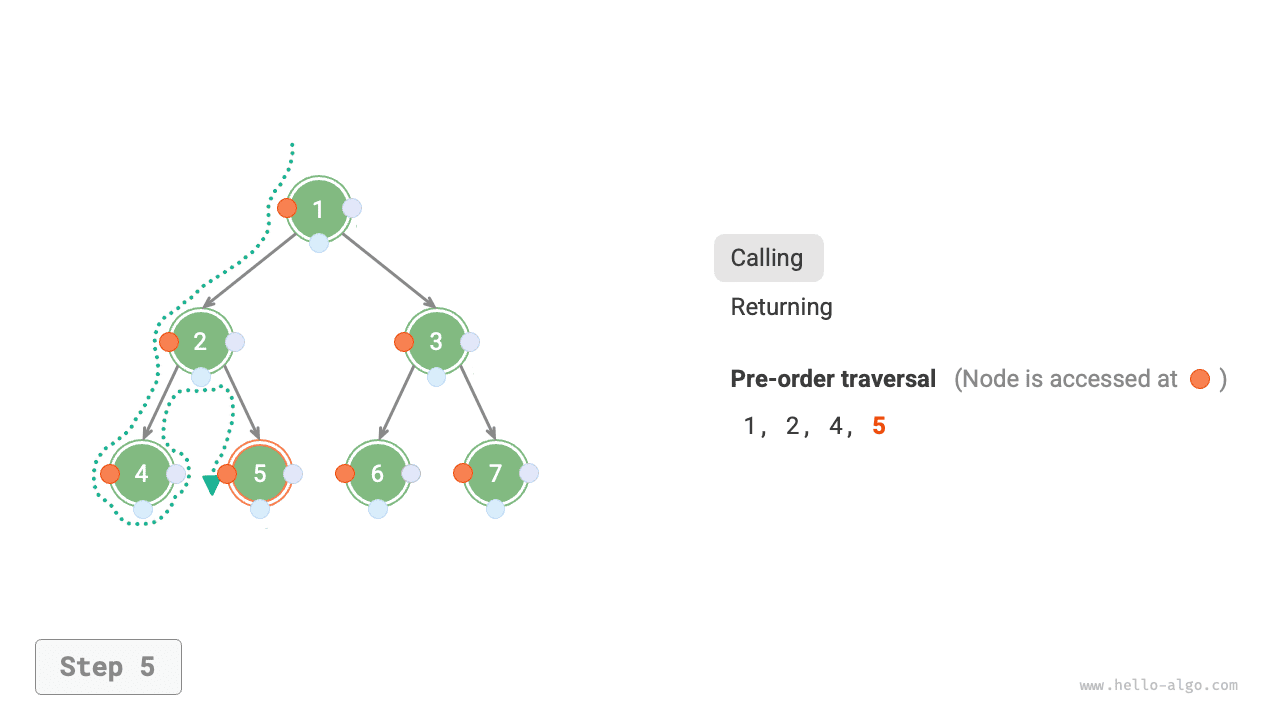
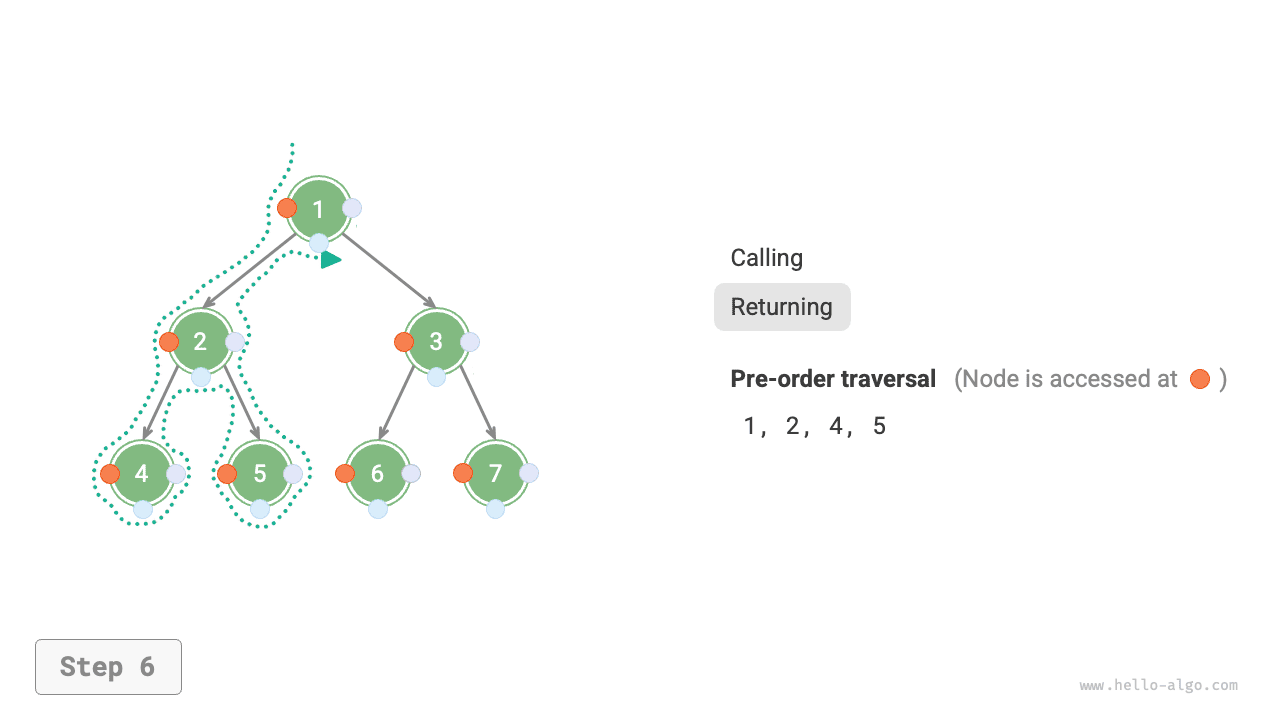
The figure below shows the recursive process of preorder traversal of a binary tree, which can be divided into two opposite phases: "descending" and "returning".
- "Descending" means making a new recursive call, during which the program visits the next node.
- "Returning" means the function call returns, indicating that the current node has been fully processed.
Complexity Analysis
- Time complexity is \(O(n)\): All nodes are visited once, using \(O(n)\) time.
- Space complexity is \(O(n)\): In the worst case, i.e., the tree degenerates into a linked list, the recursion depth reaches \(n\), and the system occupies \(O(n)\) stack frame space.