Radix Sort
The previous section introduced counting sort, which is suitable when the number of items \(n\) is large but the value range \(m\) is small. Suppose we need to sort \(n = 10^6\) student IDs, each of which is an 8-digit number. Then the value range \(m = 10^8\) is very large. Using counting sort would require a large amount of memory, whereas radix sort avoids this problem.
Radix sort is based on the same core idea as counting sort: it also sorts by counting occurrences. Building on this, radix sort exploits the positional relationship among digits and sorts them one digit at a time to obtain the final result.
Algorithm Flow
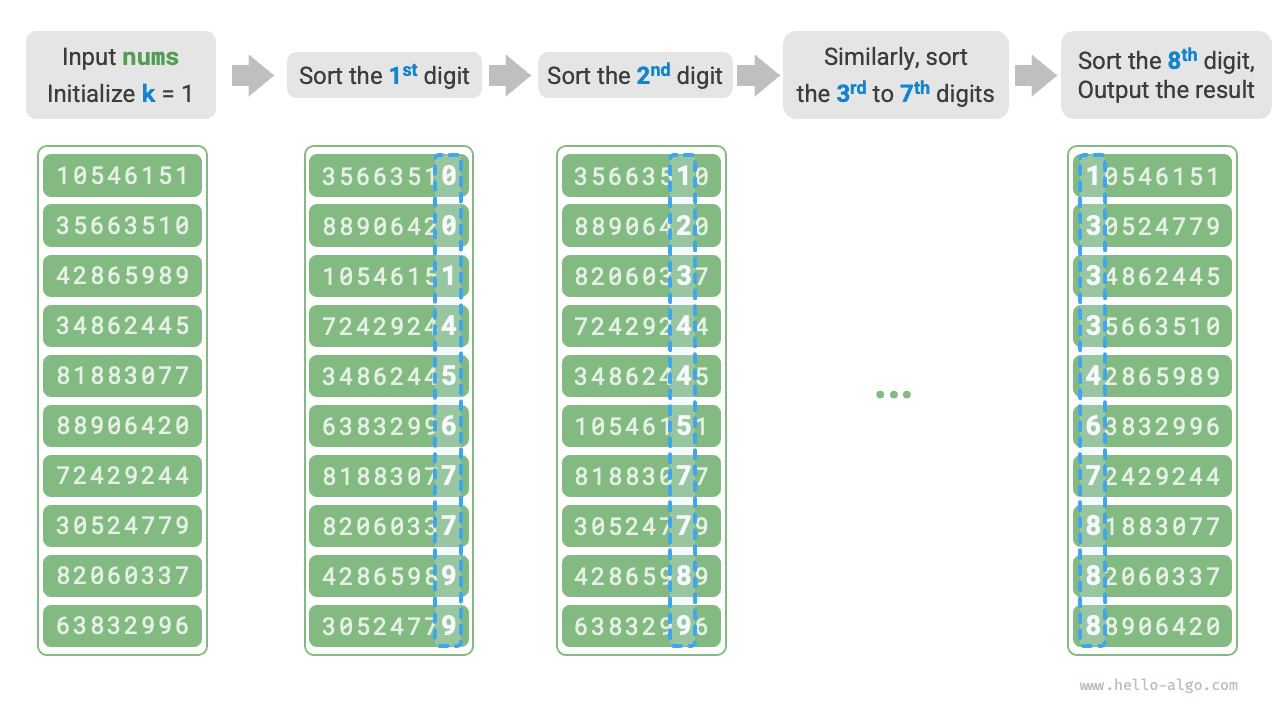
Taking student ID data as an example, assume the lowest digit is the \(1\)st digit and the highest digit is the \(8\)th digit. The flow of radix sort is shown in the figure below.
- Initialize the digit \(k = 1\).
- Perform "counting sort" on the \(k\)th digit of the student IDs. After completion, the data will be sorted from smallest to largest according to the \(k\)th digit.
- Increase \(k\) by \(1\), then return to step
2.and continue iterating until all digits are sorted, at which point the process ends.
Next, let us look at the code. For a number \(x\) in base \(d\), its \(k\)th digit \(x_k\) can be obtained with the following formula:
Here, \(\lfloor a \rfloor\) denotes rounding the floating-point number \(a\) down, and \(\bmod \: d\) denotes taking the remainder modulo \(d\). For student ID data, \(d = 10\) and \(k \in [1, 8]\).
Additionally, we need to slightly modify the counting sort code to make it sort based on the \(k\)th digit of the number:
Why start sorting from the lowest digit?
In successive sorting passes, a later pass overrides the result of an earlier one. For example, if the first pass yields \(a < b\) but the second yields \(a > b\), then the result of the second pass prevails. Because higher-order digits have higher priority than lower-order digits, we should sort the lower digits first and then the higher digits.
Algorithm Characteristics
Compared with counting sort, radix sort is suitable for larger value ranges, but only when the data can be represented with a fixed number of digits and that digit count is not too large. For example, floating-point numbers are not well suited to radix sort because the digit count \(k\) can be too large, potentially leading to time complexity \(O(nk) \gg O(n^2)\).
- Time complexity of \(O(nk)\), non-adaptive sorting: Let the number of items be \(n\), let the values be represented in base \(d\), and let the maximum number of digits be \(k\). Counting sort on one digit takes \(O(n + d)\) time, so sorting all \(k\) digits takes \(O((n + d)k)\) time. In practice, \(d\) and \(k\) are usually relatively small, so the overall time complexity approaches \(O(n)\).
- Space complexity of \(O(n + d)\), non-in-place sorting: Same as counting sort, radix sort requires auxiliary arrays
resandcounterof lengths \(n\) and \(d\). - Stable sort: When counting sort is stable, radix sort is also stable; when counting sort is unstable, radix sort cannot guarantee correct sorting results.