Selection Sort
Selection sort works very simply: in each round, it selects the smallest element from the unsorted interval and places it at the end of the sorted interval.
Assume the array has length \(n\). The procedure of selection sort is shown in the figure below.
- Initially, all elements are unsorted, i.e., the unsorted (index) interval is \([0, n-1]\).
- Select the smallest element in the interval \([0, n-1]\) and swap it with the element at index \(0\). After completion, the first element of the array is sorted.
- Select the smallest element in the interval \([1, n-1]\) and swap it with the element at index \(1\). After completion, the first 2 elements of the array are sorted.
- And so on. After \(n - 1\) rounds of selection and swapping, the first \(n - 1\) elements of the array are sorted.
- The only remaining element must be the largest, so no further sorting is needed and the array is sorted.
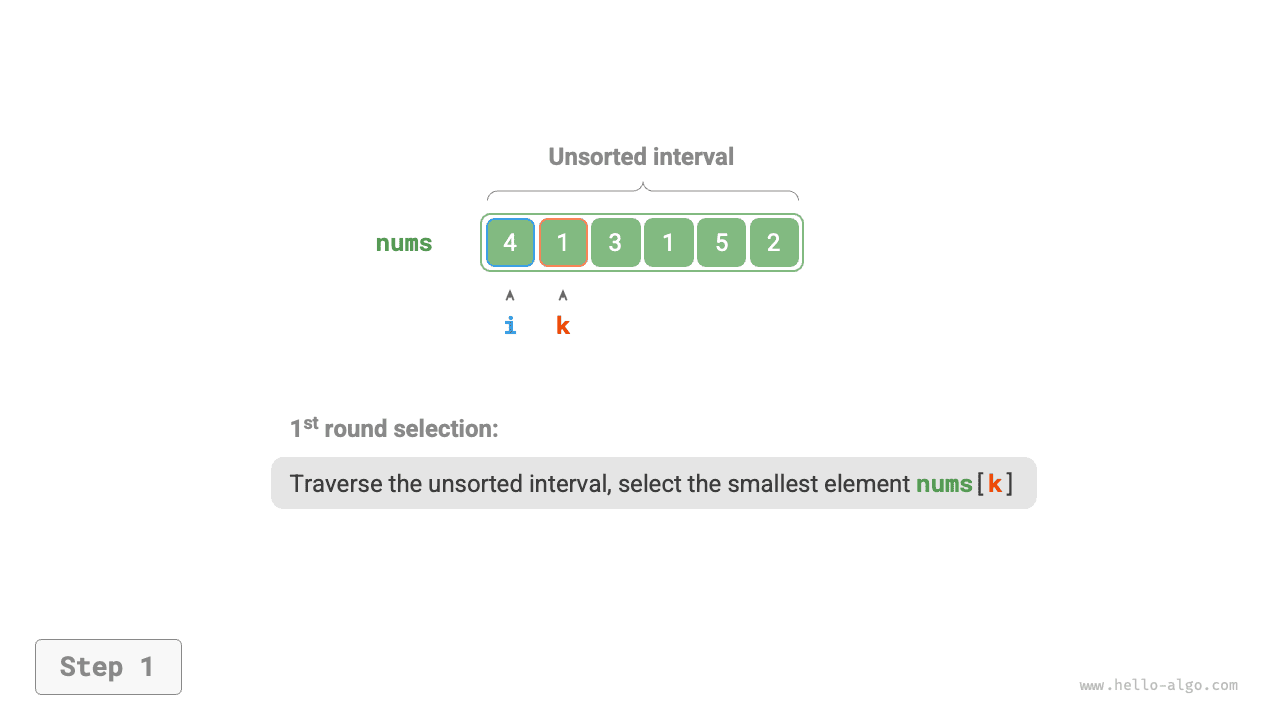
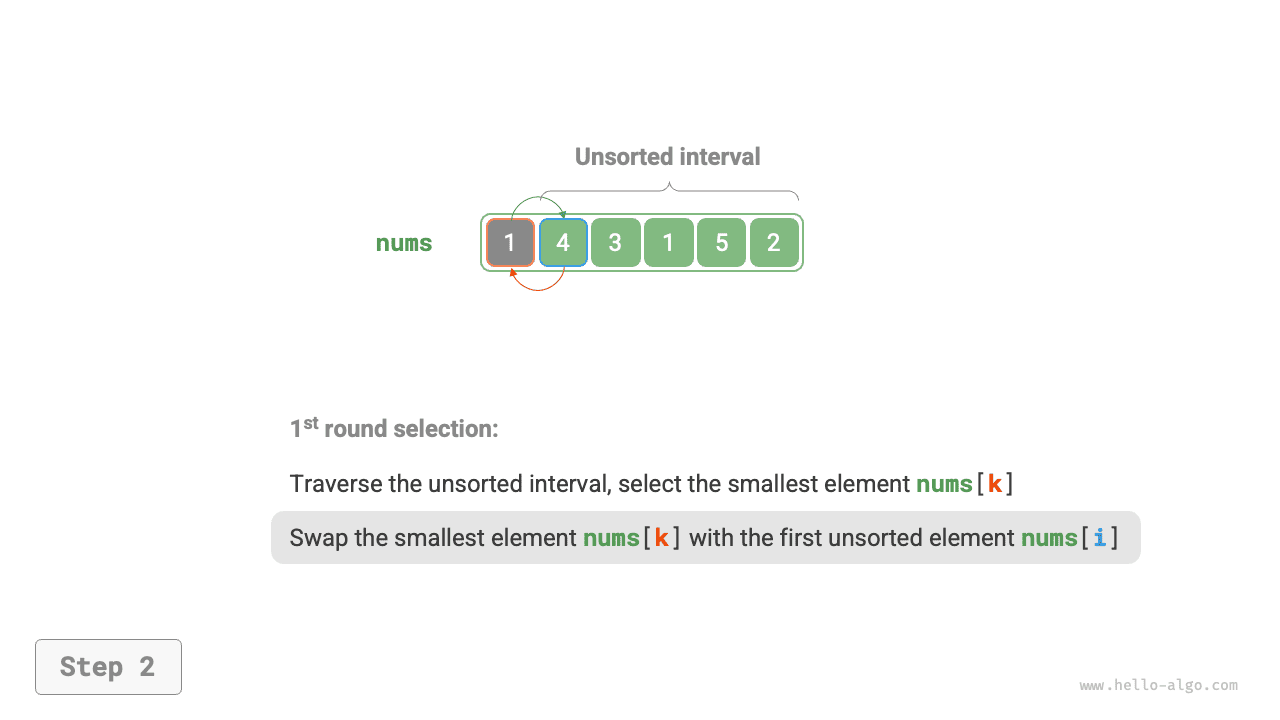
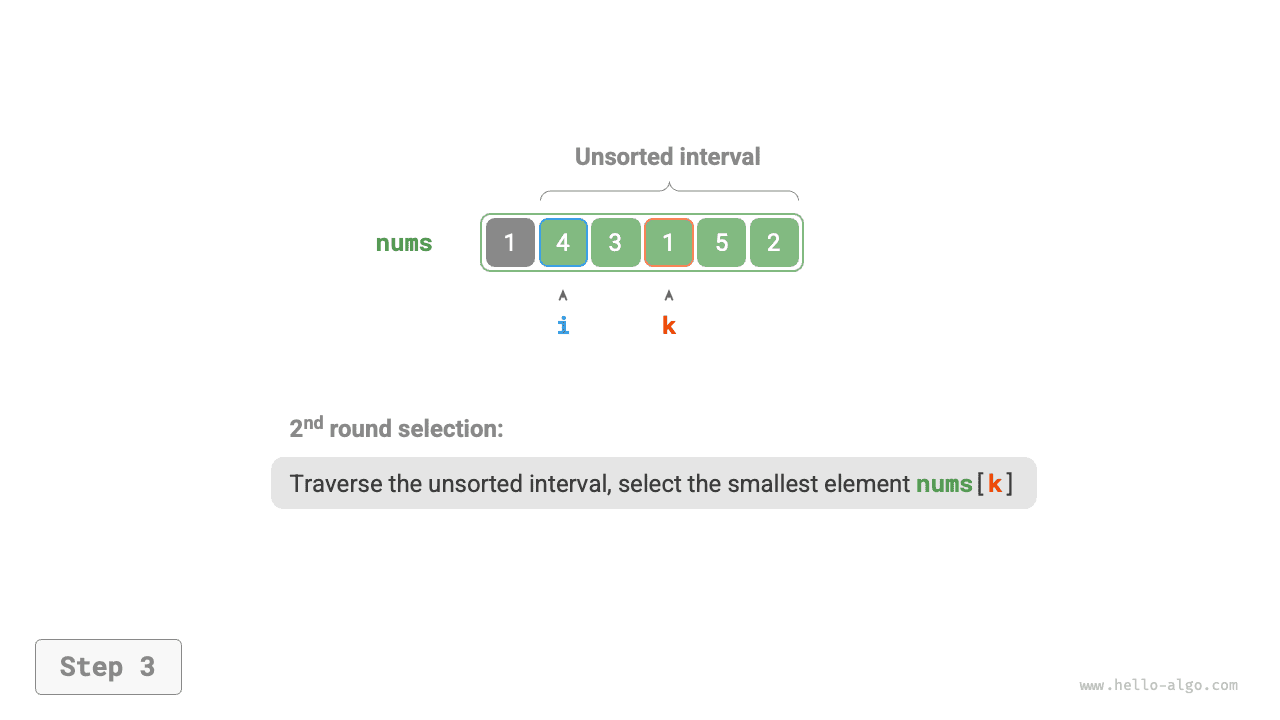
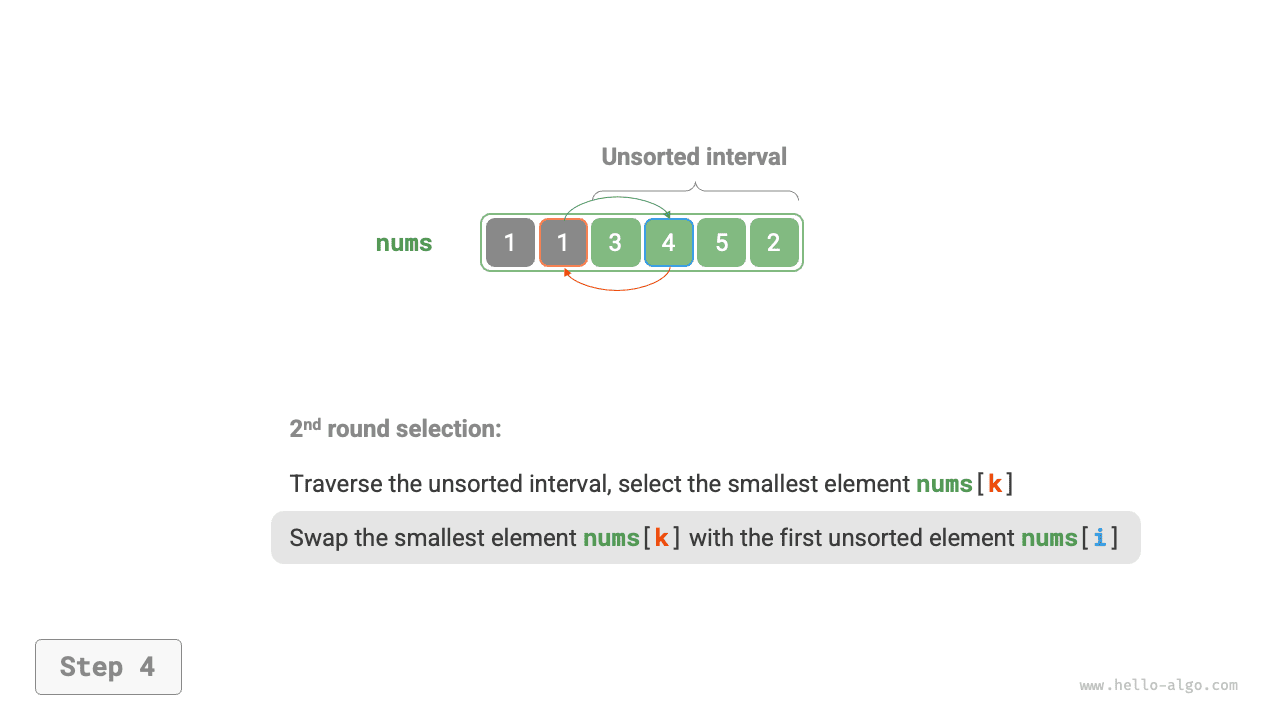
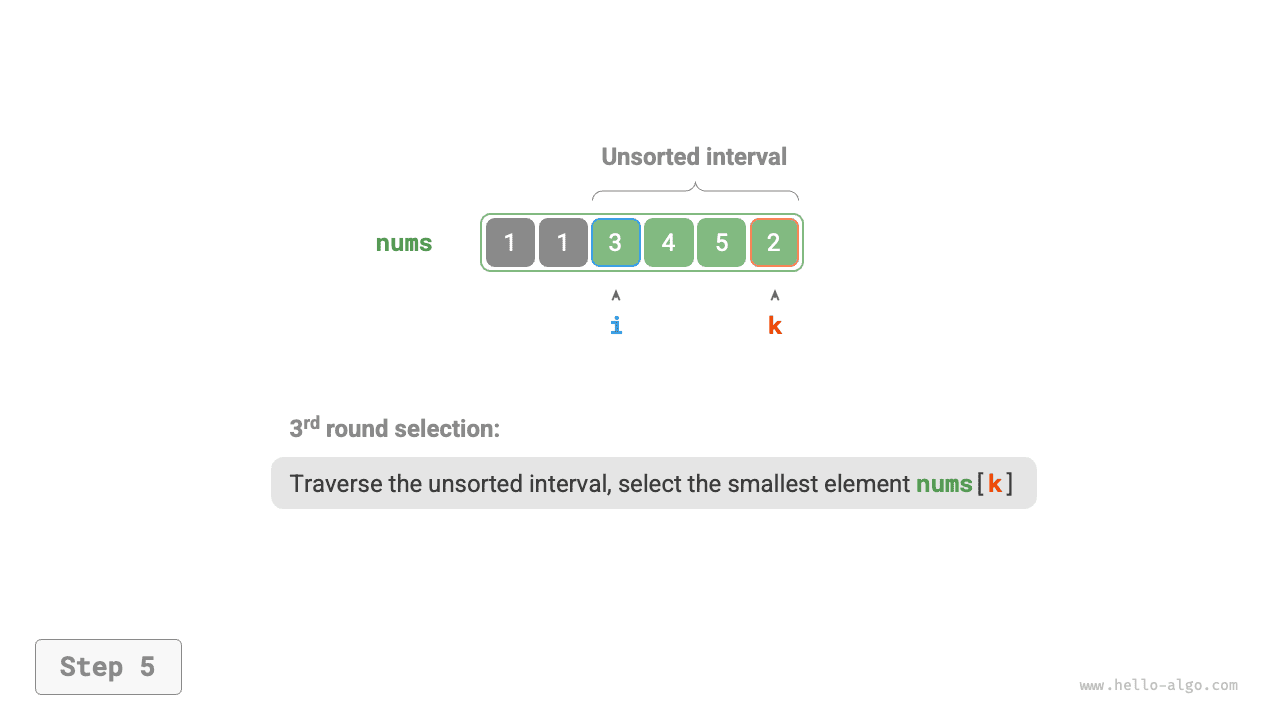
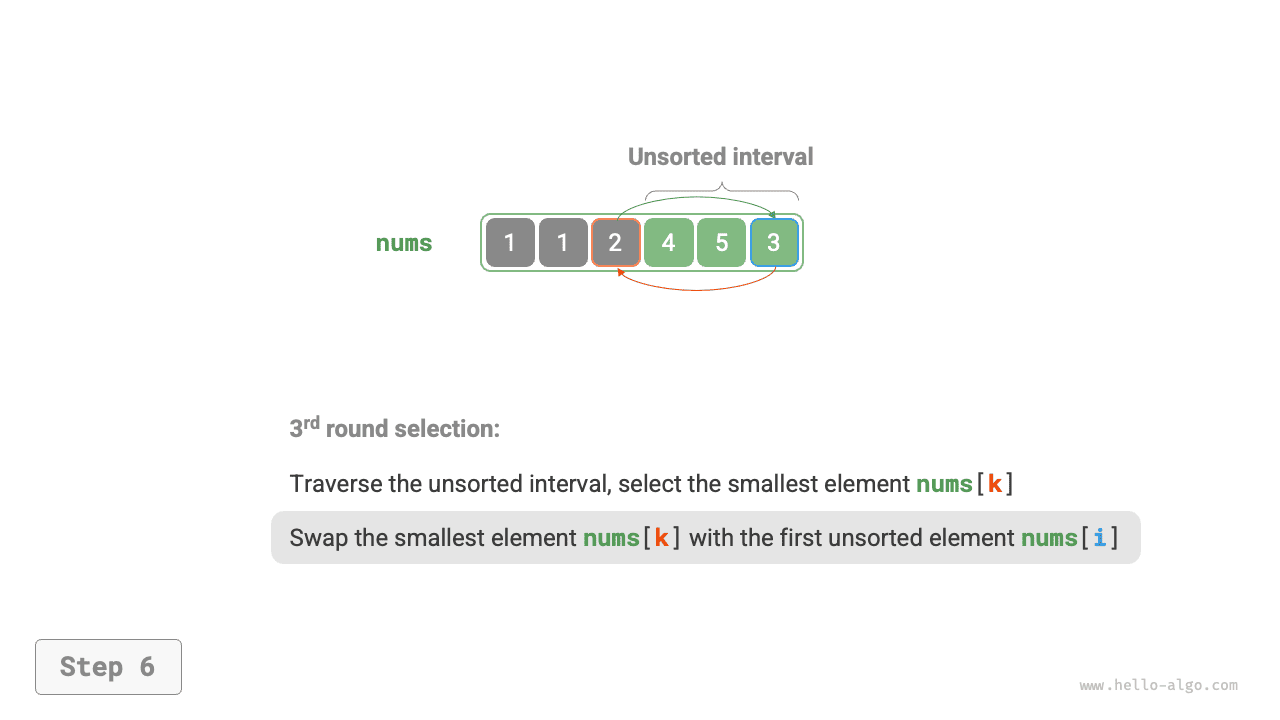
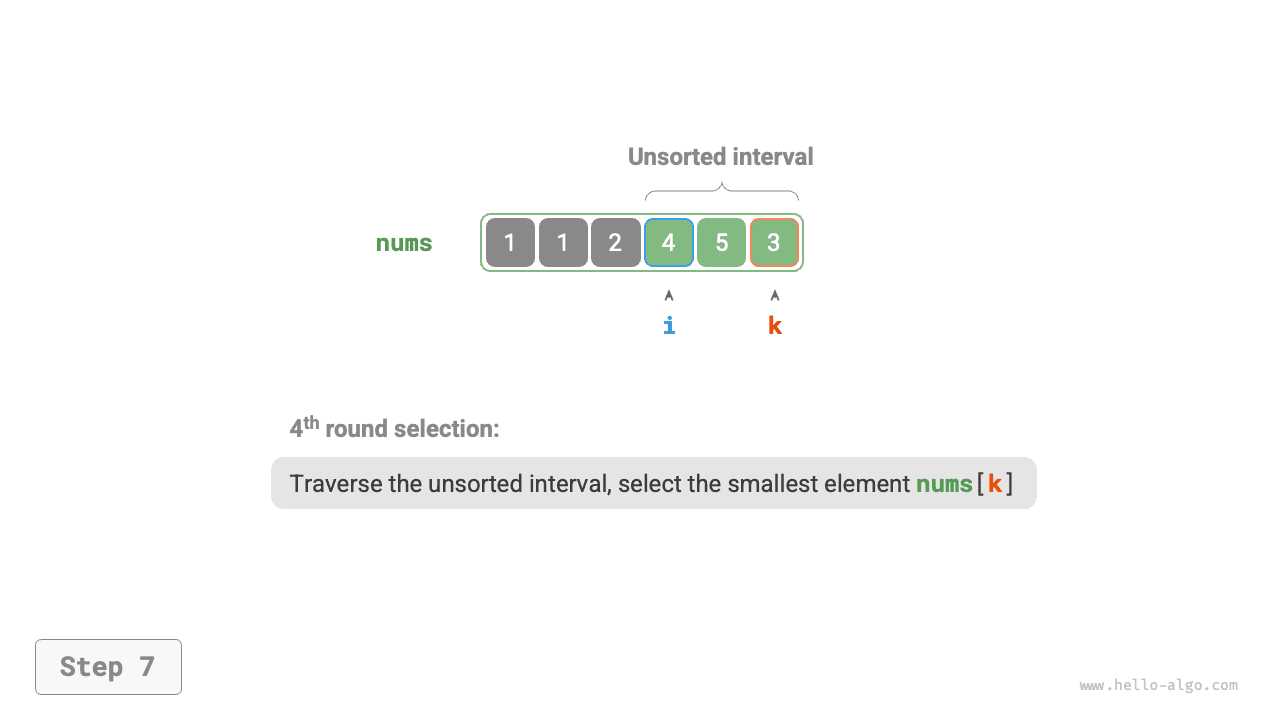
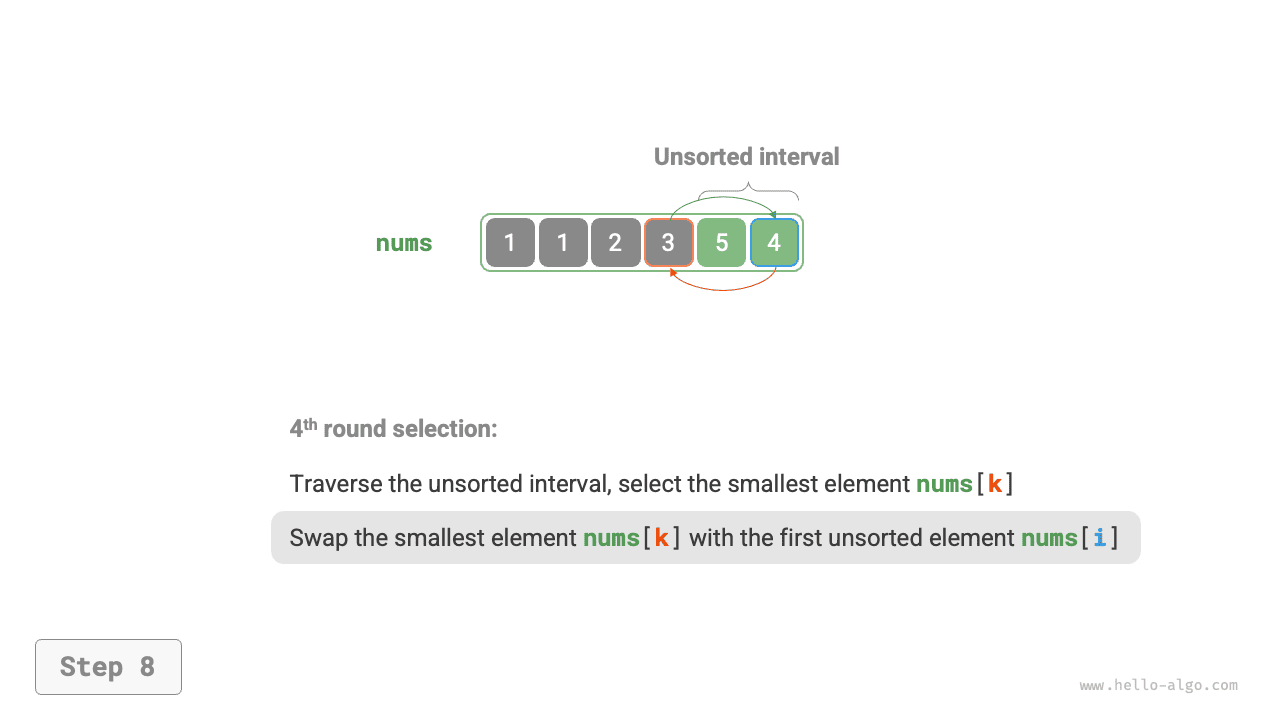
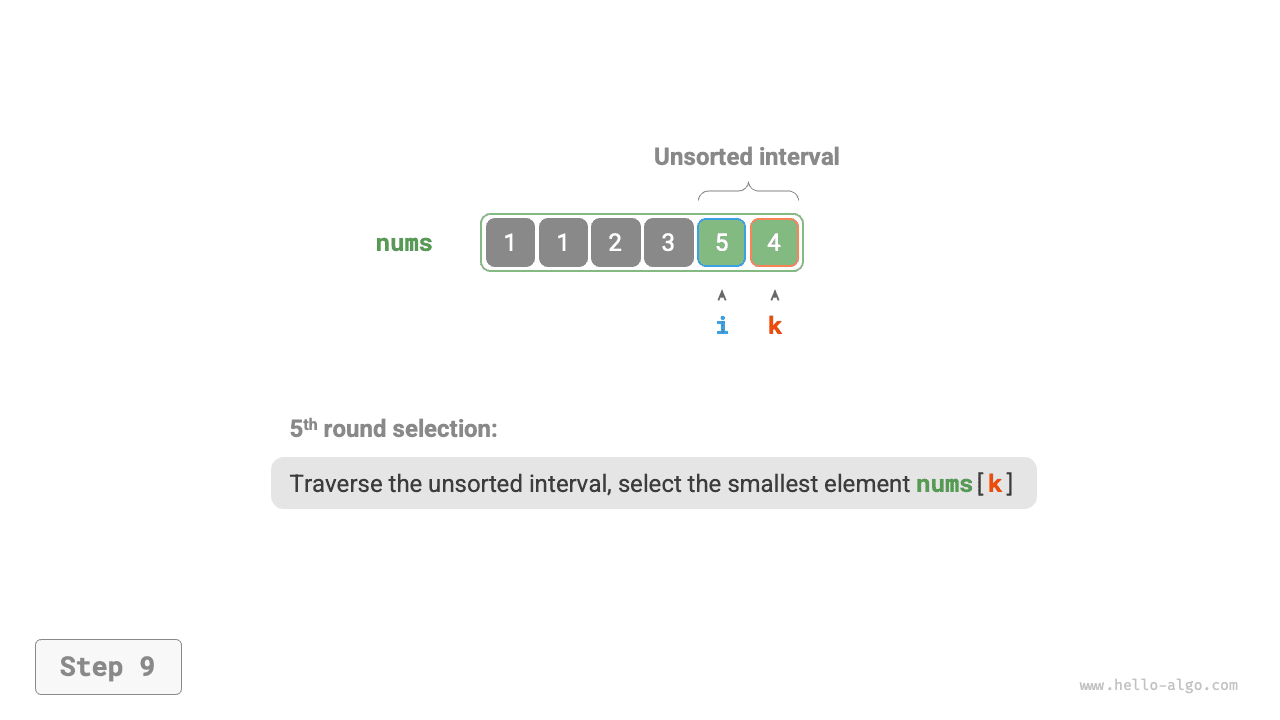
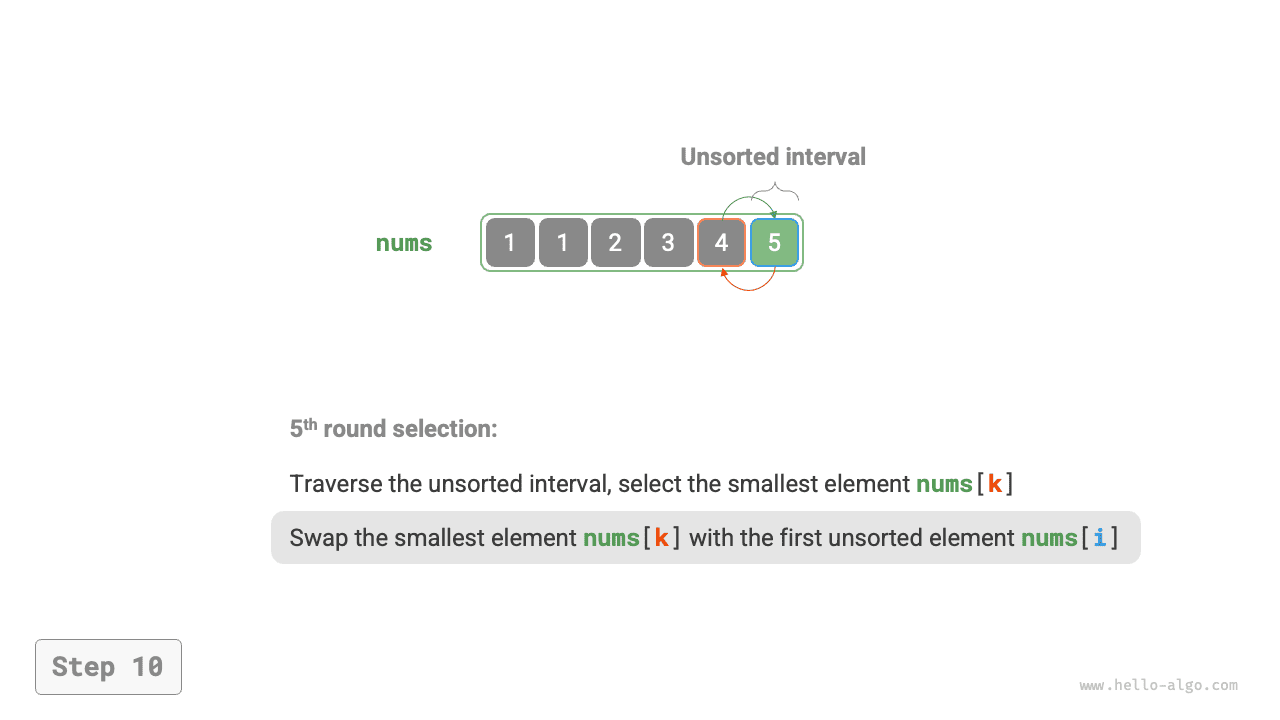
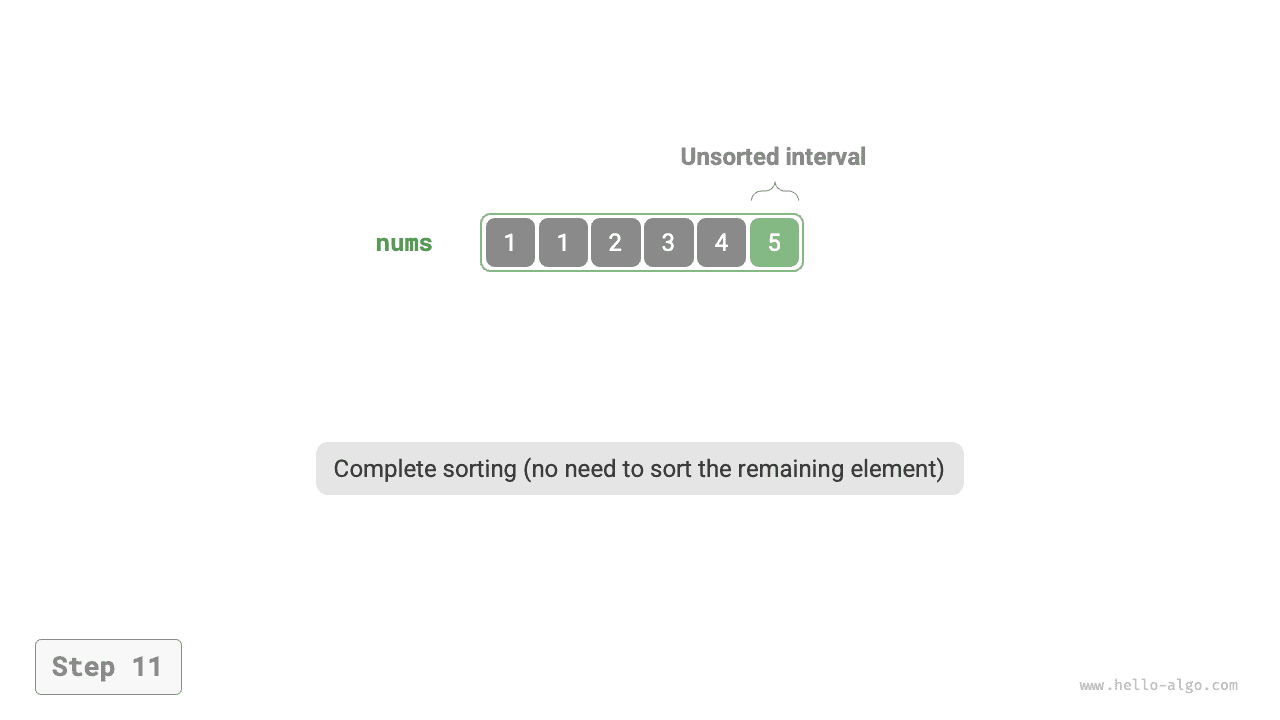
In the code, we use \(k\) to track the smallest element within the unsorted interval:
Algorithm Characteristics
- Time complexity \(O(n^2)\), non-adaptive sorting: The outer loop has \(n - 1\) rounds in total. The length of the unsorted interval in the first round is \(n\), and the length of the unsorted interval in the last round is \(2\). That is, the rounds of the outer loop contain inner loops with \(n\), \(n - 1\), \(\dots\), \(3\), and \(2\) iterations, summing to \(\frac{(n - 1)(n + 2)}{2}\).
- Space complexity \(O(1)\), in-place sorting: Pointers \(i\) and \(j\) use a constant amount of extra space.
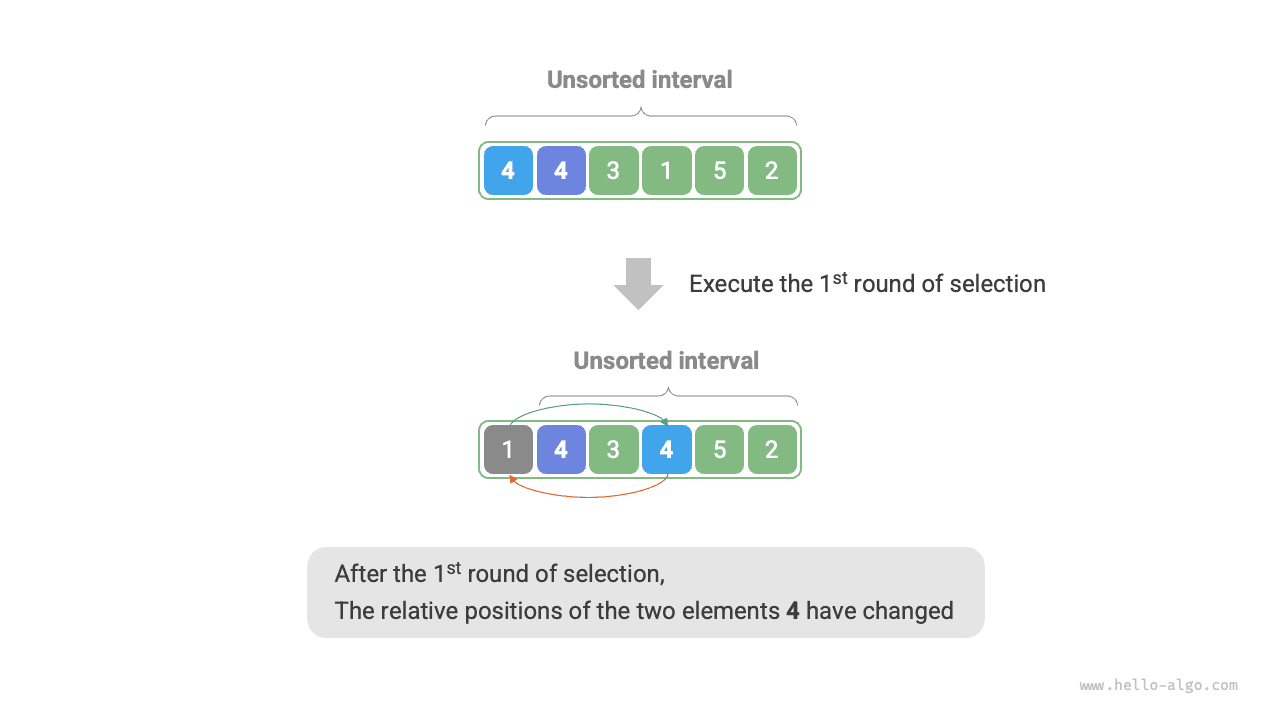
- Unstable sorting: As shown in the figure below, element
nums[i]may be swapped to the right of an element equal to it, causing a change in their relative order.